
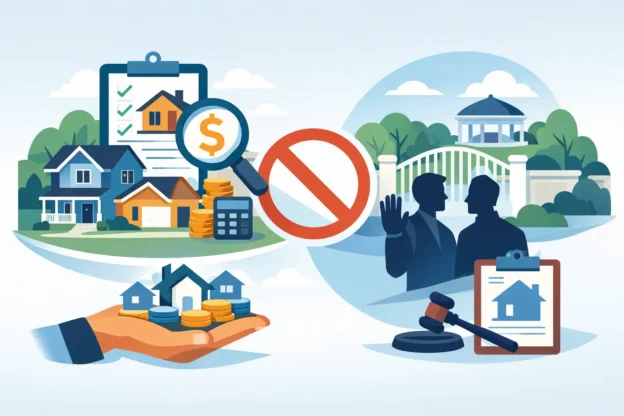
A buyer has an accepted offer, a valid FHA preapproval, and a closing date on the calendar. Then the lender requests the condominium questionnaire, master insurance policy, budget, and governing documents. That is when the real question surfaces: can an HOA block FHA financing? Yes – although an HOA usually does not have the legal authority to simply veto an FHA loan because it dislikes the loan program.
What the association can do, intentionally or not, is create conditions that prevent the lender from confirming FHA eligibility. In condominium transactions, FHA financing depends on both the borrower and, in many cases, the project. If the HOA, its manager, or the project itself cannot satisfy FHA condominium requirements, the lender may be unable to close the FHA loan.
For buyers, sellers, agents, and boards, the distinction matters. An FHA denial tied to the condominium is not necessarily a credit problem or a buyer problem. It is often a documentation, insurance, budget, litigation, delinquency, or project-approval problem that requires a different solution.
Can an HOA block FHA financing through its rules?
An HOA cannot rewrite federal lending guidelines, and it generally cannot prohibit an owner from choosing FHA financing solely by adopting a preference for conventional buyers. But the association’s declaration, bylaws, operating practices, and financial condition all affect whether a lender can approve a loan in the community.
Some restrictions are immediate red flags. A provision that limits ownership or occupancy in a way that conflicts with fair housing requirements can create serious issues. Transfer restrictions, excessive approval rights over purchasers, or financing-related restrictions also deserve close review. A reasonable right of first refusal may be workable, but a board process that delays or conditions a sale beyond what the lender can accept can put the transaction at risk.
More commonly, FHA financing is blocked by what the HOA fails to provide. The lender needs reliable, current information to assess the project. If the management company will not complete the questionnaire, cannot produce the master policy, gives inconsistent delinquency figures, or takes weeks to respond, the loan can miss its contingency and closing deadlines.
That is not merely an administrative inconvenience. In a condo purchase, incomplete HOA information can make the lender unable to document compliance with FHA requirements. The practical result is the same as a denial: the buyer must change financing, obtain more time, or walk away.
Why FHA condo eligibility is different
FHA evaluates risk at two levels. The borrower must meet FHA underwriting standards for income, assets, credit, and the property appraisal. The condominium project may also need to meet FHA standards related to its legal structure, financial health, insurance, occupancy, commercial use, and marketability.
A project with an active FHA approval is often the cleanest path, but approval status should never be assumed from an old listing, prior sale, or a manager’s verbal confirmation. Approvals can expire, and a development’s current condition may still require review by the lender.
When a project is not approved, a lender may be able to pursue a single-unit approval. This is not a shortcut around an unhealthy association. It is a defined FHA pathway that still requires sufficient project-level documentation and compliance. Whether it is available depends on the property type, the project, the lender’s authority, and the facts of the transaction.
That is why a seller’s statement that “FHA is okay here” is not enough. The buyer’s lender must confirm the applicable approval route before the financing contingency becomes a problem.
The HOA issues most likely to stop an FHA closing
No single item automatically produces the same outcome in every transaction. FHA requirements, lender overlays, and the project’s full profile all matter. Still, several HOA conditions repeatedly cause delays, additional review, or ineligibility.
Inadequate master insurance
The HOA must carry appropriate master hazard insurance, and the lender must be able to review the evidence of coverage. Gaps in coverage, insufficient limits, unclear deductibles, excluded perils, or a policy that does not properly cover the condominium can stop underwriting.
Flood coverage can be equally consequential when the project is in a required flood zone. An association that lets coverage lapse or cannot promptly provide a compliant certificate places every pending transaction at risk, not just the FHA loan.
Financial weakness and delinquent assessments
FHA lenders examine the association’s financial position rather than treating the HOA as a background detail. High delinquency levels, inadequate operating funds, persistent deficits, missing budgets, and weak reserves can suggest that the project may not be financially stable.
A special assessment is not automatically fatal. The key questions are why it was imposed, whether it is funded, who is responsible for payment, and whether it points to deferred maintenance or a larger financial problem. A well-documented roof assessment with a clear repayment plan is very different from an emergency assessment issued because the association has no cash and major repairs are unresolved.
Litigation, safety, and deferred maintenance
Pending litigation requires careful review. Routine collection matters may be less concerning than litigation involving construction defects, structural conditions, habitability, safety, or the association’s financial capacity. The lender needs enough detail to determine the actual risk, not just a checkbox showing that litigation exists.
Physical condition issues can also derail financing. Water intrusion, unsafe balconies, failing building systems, unaddressed code violations, or material deferred maintenance may affect appraisal, insurance, project eligibility, or all three. Boards should not assume a repair issue is isolated simply because it is limited to common elements. Common-element conditions are central to condominium finance.
Incomplete or outdated project documents
The budget, balance sheet, reserve information, insurance declarations, recorded declarations, bylaws, amendments, and current questionnaire responses need to tell a consistent story. Outdated documents or conflicting answers force lenders to escalate review.
This is where transaction timing often collapses. A manager may believe that a resale package is sufficient, while the lender needs project-level information not included in the standard package. Ordering documents early gives the parties time to identify gaps before the loan reaches final underwriting.
What buyers and agents should do before writing an FHA offer
The best time to investigate condominium eligibility is before the offer is submitted, not after inspections are complete. Confirm whether the property is a condominium, whether the project has an active FHA approval, and whether the buyer’s lender can use that approval for the specific unit and loan.
If the project is not approved, ask the lender immediately whether a single-unit approval may be an option. That conversation should happen before promising an aggressive closing date. A lender that does not handle FHA condominium reviews regularly may not have the process, authority, or appetite to pursue the available approval path.
Agents should also ask for the HOA’s document turnaround time and fees. A fast answer from a property manager is valuable, but it is not a substitute for an actual review. The lender must assess the documents, and late surprises frequently involve insurance, litigation, assessment delinquencies, or a budget that does not support the questionnaire response.
For sellers, early due diligence protects the buyer pool. If a unit is marketed as FHA eligible without verification and the project later fails review, the listing can lose momentum and the seller may face a second round of negotiations with the next buyer.
What HOA boards and managers can control
HOA leaders cannot guarantee that every buyer will qualify, but they can eliminate preventable project-level barriers. The practical work is maintaining compliant insurance, current financial records, accurate delinquency reporting, accessible governing documents, and a responsive process for lender requests.
Boards should also review amendments and enforcement practices before they become a financing issue. A restriction adopted to solve a local governance concern can have unintended effects on mortgage eligibility and resale value. Legal review of CC&Rs and financing-focused condominium consulting can identify language or operating practices that create unnecessary friction.
When an FHA transaction is already delayed, the fastest solution is usually not speculation about whether the lender is being difficult. It is identifying the exact missing or unacceptable item, determining whether it can be corrected, and providing clear documentation. FHA Pros helps stakeholders evaluate FHA project status, single-unit approval options, governing documents, and the data points that determine whether a condo transaction can move forward.
An HOA does not need to announce a ban on FHA loans to block them in practice. A well-run association protects owners’ financing options by treating insurance, records, budgets, and lender responses as part of the property’s marketability – not as back-office paperwork.