
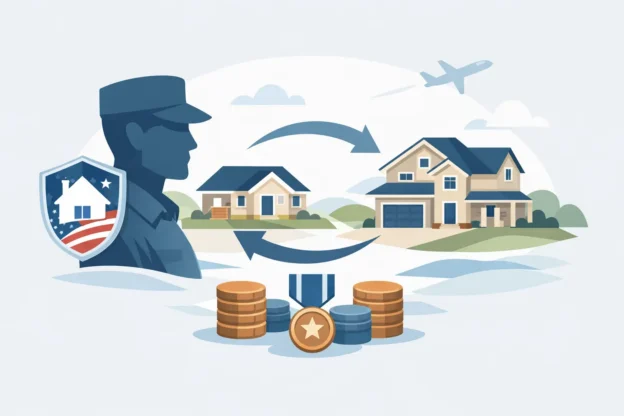
A VA buyer can reuse entitlement, but the answer is not simply yes after every sale. The determining issue is whether the prior VA loan has been paid off and the VA guarantee has been released, or whether another eligible veteran has substituted entitlement. Getting this wrong can delay a purchase, reduce available borrowing power, or leave a seller’s entitlement tied to a home they no longer own.
For buyers, sellers, agents, lenders, and servicers, entitlement must be treated as a closing-critical item. A Certificate of Eligibility is the starting point, but it is not a substitute for reviewing the existing VA loan, the payoff plan, and any proposed assumption.
Can VA Buyers Reuse Entitlement? Yes, With Restoration
VA entitlement is the portion of the VA guaranty available to a qualified borrower. A borrower does not receive a one-time VA loan and lose the benefit forever. Entitlement can be restored and used again, and in some cases a borrower can use remaining entitlement while another VA loan is still outstanding.
The cleanest path is straightforward: the veteran sells the property, the existing VA loan is paid off at closing, and the lender or servicer reports the payoff. Once the VA processes the release of its guaranty, the veteran can generally seek restoration of entitlement for a new VA-backed purchase.
Timing matters. A prior loan payoff may appear in a settlement statement immediately, while the VA loan record and Certificate of Eligibility can take longer to reflect the change. A lender underwriting the next VA loan needs a current entitlement calculation, not an assumption that a recent sale has already cleared the system. When the transactions are close together, the lender may need payoff documentation and additional verification before approving the new loan.
A refinance can also create a restoration path. If a VA loan is refinanced into a conventional loan and the VA loan is paid in full, the entitlement used on that VA loan may be restored. The same principle applies: the relevant question is whether the VA-guaranteed obligation was fully satisfied and released.
Selling a Home Does Not Always Restore VA Entitlement
A sale alone does not automatically restore entitlement. This distinction is especially important with assumable VA mortgages, where the existing low rate may be a major part of the property’s value.
When a buyer assumes a VA loan, the original VA loan remains in place. The assuming buyer takes over the payment obligation subject to servicer approval, but the original borrower’s entitlement usually remains committed to that loan unless entitlement substitution occurs. A non-veteran can potentially assume a VA loan if qualified by the servicer, but that buyer cannot substitute VA entitlement. The seller’s entitlement therefore stays tied up, even after title transfers.
A veteran buyer who assumes the loan may be able to substitute their own available entitlement for the seller’s. When the substitution is approved, the original veteran’s entitlement can be released. This is often the preferred structure when the seller needs full VA buying power for another purchase.
Do not confuse a release of liability with a substitution of entitlement. They solve different problems. A release of liability addresses whether the original borrower remains responsible for the assumed loan. A substitution of entitlement addresses whether the original borrower’s VA entitlement is freed. A seller may receive one without receiving the other, depending on the transaction structure and servicer approval.
This is why assumption marketing should be precise. Advertising a loan as assumable can attract serious buyers, but agents and sellers should identify early whether the buyer is a veteran with available entitlement, whether substitution will be requested, and whether the seller intends to buy again with a VA loan.
A practical assumption example
Consider a veteran seller with a 3 percent VA loan and a significant remaining balance. A civilian buyer assumes the loan after meeting the servicer’s credit and income requirements. The seller may be released from future liability if the servicer approves that request, but the VA guaranty remains attached to the outstanding loan. If the seller later applies for another VA loan, the lender must account for the entitlement still used by the assumed mortgage.
Now change the buyer to an eligible veteran with sufficient unused entitlement. If that buyer assumes the loan and receives approval to substitute entitlement, the seller’s entitlement can be restored. The assumption retains its pricing benefit for the buyer while giving the seller a clearer path to a new VA purchase.
Remaining Entitlement Can Support Another VA Loan
Full restoration is not always required. Some veterans have remaining entitlement and may be able to obtain another VA loan while the prior VA loan is still open. This situation can arise when a borrower keeps a current home, has an assumed loan still using part of their entitlement, or is moving before selling.
The available amount depends on the entitlement already committed, the new loan amount, the property’s county, lender guidelines, and the borrower’s overall qualification. VA loan limits do not cap the loan amount for borrowers with full entitlement, but county loan limits remain relevant in calculating guaranty and possible down payment requirements when entitlement is partial.
That distinction has real financial consequences. A borrower with partial entitlement may still qualify for a second VA loan, but the lender could require a down payment to make up for a guaranty shortfall. The borrower must also qualify with both housing obligations if the former home has not sold or its rental income cannot be used under underwriting rules.
A lender should calculate this before the buyer writes an offer. Waiting until final underwriting can turn an expected zero-down purchase into a transaction requiring cash the buyer did not plan to bring.
What to Verify Before Listing, Assuming, or Buying
VA entitlement questions should be addressed at the beginning of the transaction, not during the final week before closing. The right documentation and coordination reduce avoidable delays.
For a purchase or sale involving a prior VA loan, verify these items early:
- The borrower’s current Certificate of Eligibility and the entitlement shown as charged.
- Whether the prior VA loan will be paid off, refinanced, or assumed.
- Whether an assumption buyer is eligible and whether substitution of entitlement will be requested.
- Whether the seller needs full entitlement for an upcoming VA purchase or can proceed with partial entitlement.
- Whether the servicer has provided its specific assumption package, qualification standards, processing timeline, and release requirements.
The loan servicer controls much of the assumption process, while the new lender is responsible for underwriting the next purchase loan. Those parties may need different documentation. A payoff demand, closing disclosure, recorded deed, assumption agreement, and entitlement substitution approval can each matter, depending on the structure.
For agents, the operational takeaway is simple: do not promise that an assumable VA loan will free the seller to obtain another VA loan. Frame it accurately. The loan may be assumable, but entitlement restoration depends on payoff or approved substitution. That disclosure protects the seller’s next move and helps buyers understand why their veteran status and available entitlement may affect the offer’s strength.
When Professional Review Is Worth It
A standard sale with a conventional payoff is usually manageable with early lender coordination. The risk rises when a transaction involves a VA assumption, simultaneous sale and purchase, partial entitlement, an inherited property, a pending refinance, or uncertainty about a prior loan’s payoff status.
These files require more than a quick eligibility check. They require a documented plan for the existing guaranty and the new loan. FHA Pros supports nationwide assumption transactions where entitlement, servicer procedures, and closing timelines need to align before a buyer or seller makes a decision based on a low-rate loan.
The strongest VA transaction is not the one that merely advertises an assumable rate. It is the one that confirms, in writing and early, what happens to the seller’s entitlement, the buyer’s obligation, and the financing needed for the next home.