
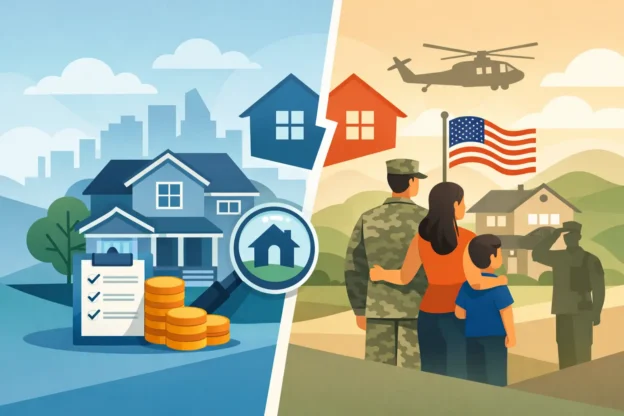
A low down payment does not automatically make two loan programs equal. In the FHA versus VA decision, the right answer depends on military eligibility, monthly payment, upfront cash, property type, and whether condominium approval could stop the transaction before it reaches closing.
FHA Versus VA Loans: The Core Difference
FHA and VA loans are government-backed mortgage programs, but they serve different borrower populations and allocate risk differently. FHA loans are insured by the Federal Housing Administration and are available to borrowers who meet lender credit, income, and property requirements. VA loans are guaranteed in part by the Department of Veterans Affairs and are generally available to eligible veterans, active-duty service members, certain National Guard and Reserve members, and qualifying surviving spouses.
That distinction drives the comparison. FHA is often a practical path for buyers who need flexible credit standards and a modest down payment. VA can be the stronger financial option for an eligible borrower because it may allow zero down payment and does not require monthly mortgage insurance.
Neither program is automatic. Lenders apply underwriting standards, appraisers review property condition, and condominium transactions introduce project-level eligibility questions that can change the available financing path.
Eligibility and Down Payment Requirements
FHA financing is broadly accessible. A borrower with a credit score of 580 or higher may qualify for the program’s 3.5% minimum down payment, while scores from 500 to 579 may require at least 10% down. Actual lender requirements can be higher. Debt-to-income ratio, payment history, income documentation, and available assets still matter.
VA financing begins with entitlement. The buyer must obtain a Certificate of Eligibility, and the lender must confirm that income, credit, residual income, and other underwriting requirements support the loan. Eligible borrowers can often finance up to the home’s appraised value without a down payment, subject to lender guidelines and the specific transaction.
A VA buyer should not assume that zero down means zero cash needed. Closing costs, prepaid taxes and insurance, appraisal costs, and any difference between the sales price and appraised value may still require funds. Sellers can contribute toward certain costs when permitted, but concessions must be structured correctly.
For non-military buyers, FHA may be the relevant low-down-payment option. For an eligible VA borrower, putting 3.5% down through FHA without first evaluating VA can mean leaving meaningful savings on the table.
Monthly Mortgage Insurance Versus the VA Funding Fee
The cost structure is where FHA and VA frequently separate.
FHA borrowers generally pay an upfront mortgage insurance premium of 1.75% of the base loan amount, which is commonly financed into the mortgage, plus an annual mortgage insurance premium paid monthly. Depending on the loan term, down payment, and loan-to-value ratio, FHA mortgage insurance can remain for many years and, for many borrowers making the minimum down payment, for the life of the loan unless the mortgage is refinanced.
VA loans do not carry monthly mortgage insurance. Instead, most VA borrowers pay a one-time VA funding fee. The fee varies based on factors such as first or subsequent use, down payment amount, and service category. It can often be financed. Veterans receiving qualifying VA disability compensation and certain other eligible borrowers may be exempt from the funding fee.
This does not mean VA is always cheaper in every situation. Interest rates, lender fees, discount points, loan amount, credit profile, and planned length of ownership all affect the real cost. But when comparable rates are available, avoiding monthly mortgage insurance can create a substantial payment advantage for an eligible VA borrower.
Credit, Income, and Property Standards
FHA is known for flexible credit access, particularly for buyers rebuilding after past financial difficulty. That flexibility is not a substitute for underwriting. Lenders still need to document stable income, assess liabilities, and confirm that the borrower can sustain the proposed housing payment.
VA underwriting also evaluates the full borrower profile, but VA places particular emphasis on residual income – the funds remaining after major monthly obligations are paid. This can protect borrowers from taking on an unsustainable payment even when the debt-to-income ratio appears workable.
Both programs require an appraisal, but the appraisal serves more than a value function. FHA and VA appraisers review whether the property meets applicable minimum property requirements. Safety issues, defective systems, inadequate access, peeling paint in older homes, and other condition concerns can create repair requirements or delay closing.
For agents and sellers, this is a transaction-planning issue. A property with deferred maintenance may still sell with FHA or VA financing, but repair negotiations and appraisal conditions need to be addressed early rather than after the contract timeline is under pressure.
Condominium Eligibility Can Decide the Loan Choice
A borrower can meet every personal qualification and still be unable to use FHA or VA financing for a condominium unit. Project eligibility matters.
For FHA condominium financing, the project may need FHA approval, unless the transaction qualifies for a single-unit approval pathway. The review can involve the association’s legal documents, insurance, budget, financial condition, owner-occupancy profile, commercial space, pending litigation, and other factors. A listing that simply says FHA approved without current, verified status creates avoidable risk.
VA condominium financing also requires attention to project approval status. A VA-eligible buyer should confirm that the project is eligible before making financing assumptions, particularly in buildings with unusual ownership structures, commercial components, insurance gaps, or unresolved association issues.
This is where lenders, agents, HOAs, and listing teams need accurate project data rather than a verbal assurance. A full project approval may expand the pool of financeable buyers. When FHA eligibility is the barrier, a properly evaluated single-unit approval can sometimes preserve an otherwise viable sale. The path depends on the project and transaction facts, not a one-size-fits-all promise.
Assumptions: FHA and VA Can Create a Resale Advantage
Both FHA and VA loans can be assumable, which has become especially valuable when an existing loan carries an interest rate below current market rates. The buyer takes over the seller’s existing loan balance, rate, and remaining term, subject to servicer and underwriting requirements.
The benefit is real, but assumptions are not simple substitutions. The buyer usually must qualify, the servicer controls the process, and the buyer must cover the gap between the assumed loan balance and the purchase price through cash, secondary financing when permitted, or another approved structure.
VA assumptions require additional attention to entitlement. A non-veteran may be able to assume a VA loan if approved, but the original veteran’s entitlement may remain tied up unless a qualified veteran substitutes entitlement. Sellers should also pursue a formal release of liability when available. Without correct documentation, a seller can face continuing exposure after the transfer.
For both programs, an assumption should be evaluated before the property is marketed as assumable. Confirm the current loan type, balance, rate, servicer process, timing, buyer qualification standards, and payoff-gap strategy. Marketing a loan feature without operational verification can derail a deal after buyers have formed expectations.
Which Loan Is the Better Fit?
FHA is often the stronger fit for a buyer who is not VA-eligible, has limited funds for a down payment, and needs a program built for flexible credit qualification. It can also be useful when a buyer plans to refinance later after improving equity, credit, or income.
VA is often the stronger fit for an eligible borrower who wants to preserve cash, avoid monthly mortgage insurance, and use earned housing benefits. A VA loan can be particularly compelling when the borrower expects to hold the mortgage long enough for recurring FHA mortgage insurance to materially affect the payment and total cost.
The property can change the answer. A condominium with unresolved FHA or VA project eligibility, a home with appraisal condition issues, or a transaction involving an assumption requires a more specific review than a basic online loan comparison can provide.
Before a buyer writes an offer or a seller advertises FHA, VA, or assumable financing, verify the financing facts that control closing: borrower eligibility, loan costs, property condition, condominium approval status, and servicer requirements. FHA Pros helps transaction partners identify and resolve those approval barriers before they become failed contracts.